
New free guide — dependence, withdrawal and how tapering actually works. Get your copy
Free patient guide

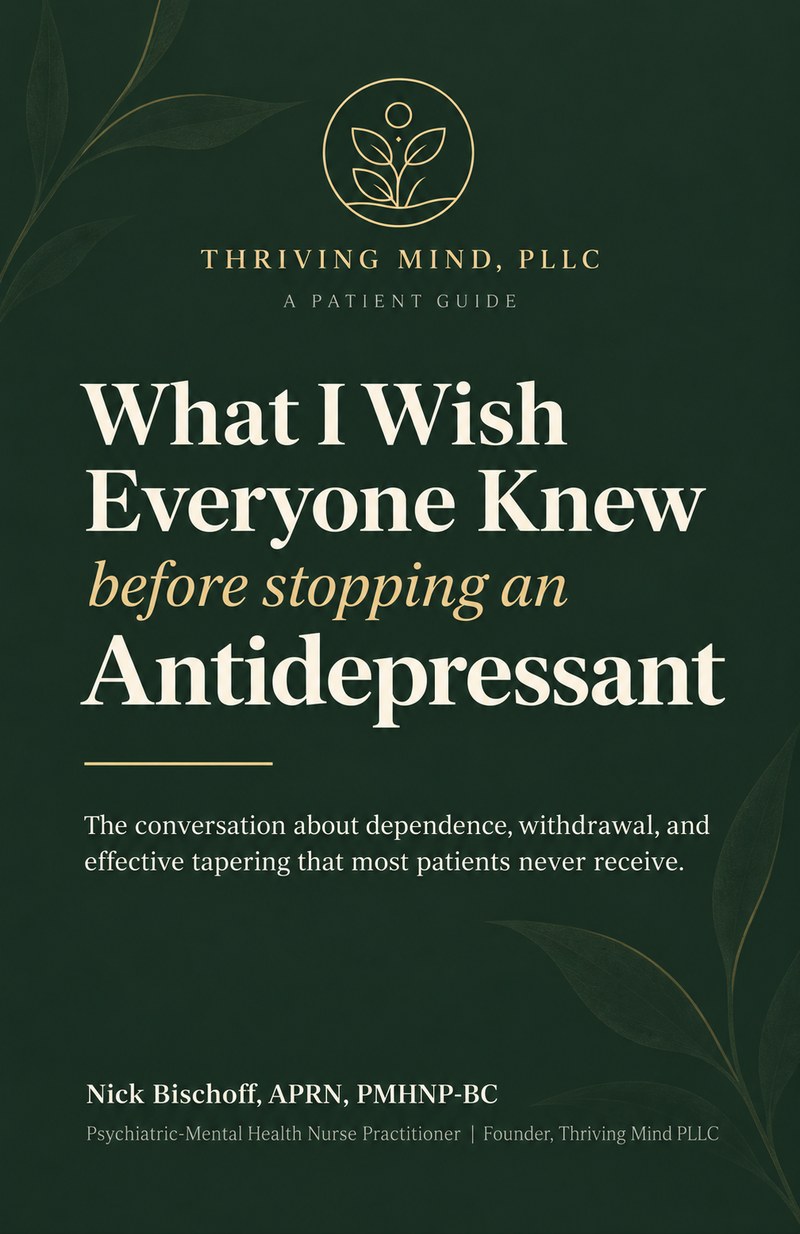
What I wish everyone knew before stopping an antidepressant.

The conversation about dependence, withdrawal and effective tapering that most patients never receive.

  • This is not an argument that you should stop. It’s what you should know before you do.
  • Written for two readers: people considering it who want to understand what they’re walking into, and people already in it who’ve been told what they’re feeling isn’t real.
  • Grounded in the published literature — Horowitz & Taylor, the Maudsley Deprescribing Guidelines, and 25+ peer-reviewed sources, all cited.

Free, and available anywhere — you don’t have to be my client to read it.
Plain EnglishWritten to be read, not decoded
25+ sourcesEvery claim cited
Prescriber-writtenAPRN, PMHNP‑BC
FreeNo card, no upsell
Why this guide exists

Almost nobody is told this before they start.

Psychiatric training is built around starting and managing medications. How to safely stop them is a gap in the field — and patients are the ones living in it.

1% of antidepressant users recall being warned about withdrawal before being prescribed the drug. Read, Cartwright & Gibson, 2018
93.5% of 708 people who tried to come off said their doctor never told them about withdrawal effects when it was first prescribed. Read et al., 2023
79% of people who had taken an antidepressant for more than two years were unable to stop when they tried. Horowitz et al., 2025
What is often said
What is true
“Withdrawal only lasts a week or two.”
That reflects guidance revised several years ago. Longer courses of withdrawal are well documented.
“This proves you still need the medication.”
Worsening after a dose reduction is not, by itself, evidence of relapse.
“These medications aren’t addictive, so there’s no withdrawal.”
Physical dependence and addiction are different things. Dependence does not require addiction.
“Just cut the pill in half for two weeks, then stop.”
A reasonable-sounding schedule that, for some people, is far too fast at the low end.
“I’ve never had a patient go through that.”
Withdrawal is frequently missed or misdiagnosed — often recorded as anxiety, relapse, or a new diagnosis.

You are not crazy, and you are not alone.

From the introduction

One thing to be clear about.

This guide is for educational purposes and is not medical advice. It does not create a clinician–patient relationship, and it is not a manual for your own taper.

Please do not stop, reduce, or change any medication on your own. Decisions about psychiatric medication should be made with a qualified clinician who knows your history. What a guide can do is show you what good care looks like, so you can recognize it and ask for it.

Who wrote it

Why I wrote this guide.

Nick Bischoff, APRN, PMHNP-BC, psychiatric nurse practitioner

I’m Nick Bischoff, APRN, PMHNP‑BC. I’m a psychiatric nurse practitioner and founder of Thriving Mind, PLLC in Louisville, Kentucky.

Like most prescribers, I was trained extensively to start and manage psychiatric medications — not to help people stop them. I had to seek out additional education, training, and clinical experience in deprescribing to help close that gap.

Too many people reach the point of stopping an antidepressant without the information or support they deserve. While there is still much we don’t know about withdrawal and deprescribing, there is also a great deal we do know that isn’t reaching patients.

That’s why I wrote this guide: to make the best information we currently have understandable and accessible to the people who need it.

Nick Bischoff, APRN · PMHNP-BC

Get your copy

You are allowed to ask hard questions.

The guide is free. Read the first chapter and you’ll know more about your own medication than you did this morning.

Get the Free Guide