
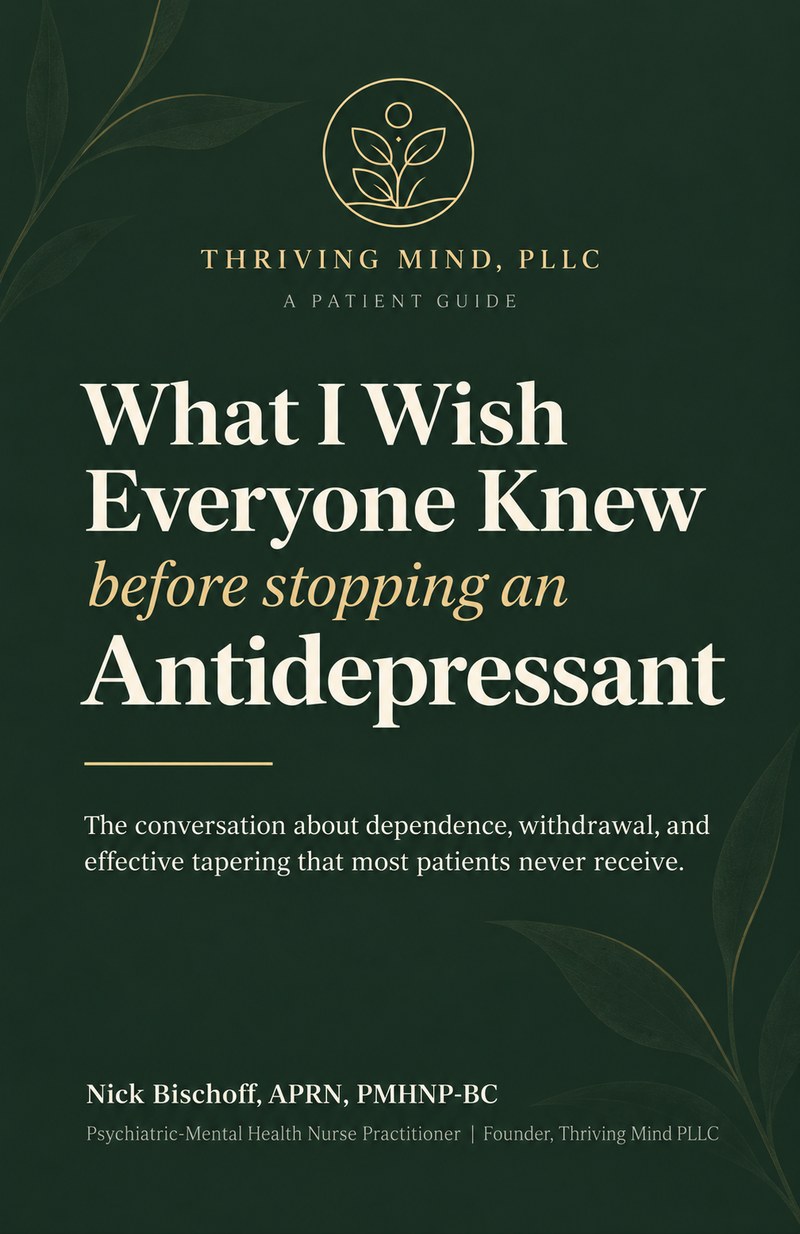
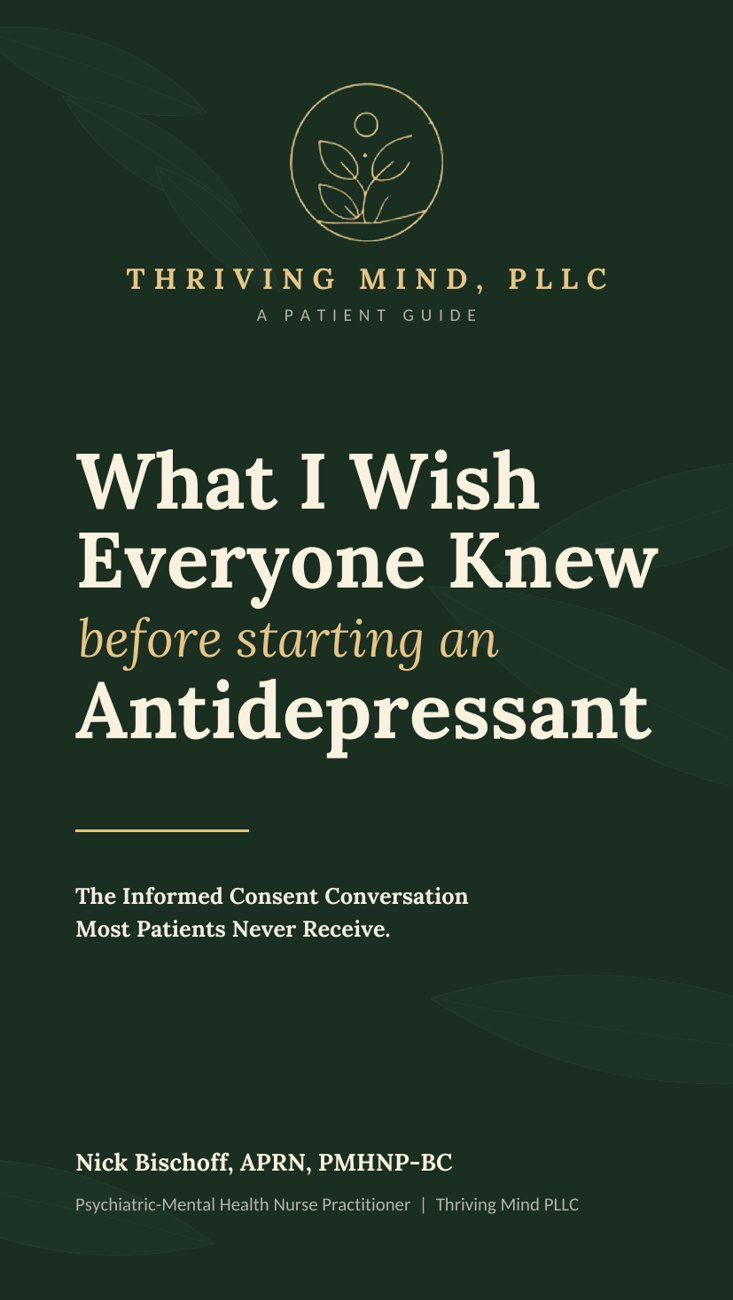
Free guide — the informed consent conversation most patients never receive. Get your copy
Free patient guide

The informed consent conversation most patients never receive.

What antidepressants actually do, what they don’t, the side effects that get left out — and the questions worth asking before you fill the prescription.

  • This is not an argument against medication. It’s the conversation that should happen before you start one.
  • This is the same informed consent conversation I give every new patient — written down, so you can take it into any appointment.
  • Every claim cited — FDA trial data, the drugs’ own labeling, the DSM-5, and the peer-reviewed literature.

Free, and available anywhere — you don’t have to be my client to read it.
Plain EnglishWritten to be read, not decoded
Fully citedFDA data, DSM-5, peer review
Prescriber-writtenAPRN, PMHNP‑BC
FreeNo card, no upsell
Start here

Your brain is not broken.

The chemical-imbalance story is still told to patients every day. It is not supported by the current evidence — and that matters enormously for what you do next.

“The main areas of serotonin research provide no consistent evidence of there being an association between serotonin and depression.”

Moncrieff et al., Molecular Psychiatry, 2023
82% of the drug response was duplicated by placebo in the FDA’s own antidepressant trial data. Kirsch et al., 2008
11–69% larger effect sizes in the published literature than in the complete data the FDA actually reviewed. Turner et al., 2008
~8 weeks median trial length these drugs were approved on. In practice, people stay on them for years. Ward et al., 2025
  • Emotional bluntingFeeling flat, numb, or watching life from a distance. Commonly reported in the 40–60% range — and often mistaken for the depression itself.
  • Sexual dysfunction and PSSDRates from 25.8% to 80.3% depending on the drug. PSSD, where symptoms persist after stopping, is recognized by the EMA and named in the FDA’s own fluoxetine labeling.
  • Mood elevation and maniaA labeled risk in the prescribing information. What happens next matters: a drug reaction is not the same as a lifelong bipolar diagnosis.
  • The FDA Black Box warningIncreased suicidal thinking and behavior under 25, most prominent in the early weeks. Roughly 4% versus 2% in the FDA’s pooled pediatric analysis.
  • Dependence and withdrawalReal and common. Estimates range from ~15% to ~56% depending on how it’s measured — and almost nobody is told before starting.
  • That medication isn’t the only optionPsychotherapy, trauma-focused work, exercise, sleep, nervous-system regulation and connection all have real evidence behind them — often with better safety profiles.

One thing to be clear about.

This guide is for education and informed consent only. It is not medical advice, and it does not create a clinician–patient relationship. Antidepressants can be helpful, appropriate, and sometimes necessary.

Do not start, stop, taper, or change any medication without working directly with a licensed clinician who knows your history. This guide is not meant to tell you what decision to make. It is meant to help you ask better questions.

The other guide

Already taking one?

For coming off

What I Wish Everyone Knew Before Stopping an Antidepressant

Dependence, withdrawal, why standard tapers fail, and what a careful one actually looks like. Eleven chapters, fully cited.

Get the stopping guide →

Why I wrote it

I’m the prescriber, and I’m the therapist.

Nick Bischoff, APRN, PMHNP-BC, psychiatric nurse practitioner

Nick Bischoff, APRN, PMHNP‑BC is a psychiatric nurse practitioner and the founder of Thriving Mind, PLLC in Louisville, Kentucky.

The most common question he gets is some version of “how do I find someone who practices like you near me?” The honest answer is that this kind of care is still rare. This guide exists because of that — it’s the informed consent conversation he gives every new patient, written down and given away, so it isn’t only the people who find him who get it.

He also teaches psychiatric nursing. He is licensed in Kentucky and Colorado — the guide, though, is for anyone.

APRN · PMHNP-BC Licensed in KY & CO Deprescribing & tapering Ketamine-assisted psychotherapy
Get your copy

You are allowed to want more than a prescription.

The guide is free. Read it before your next appointment and you’ll walk in with better questions than most patients ever get to ask.

Get the Free Guide